


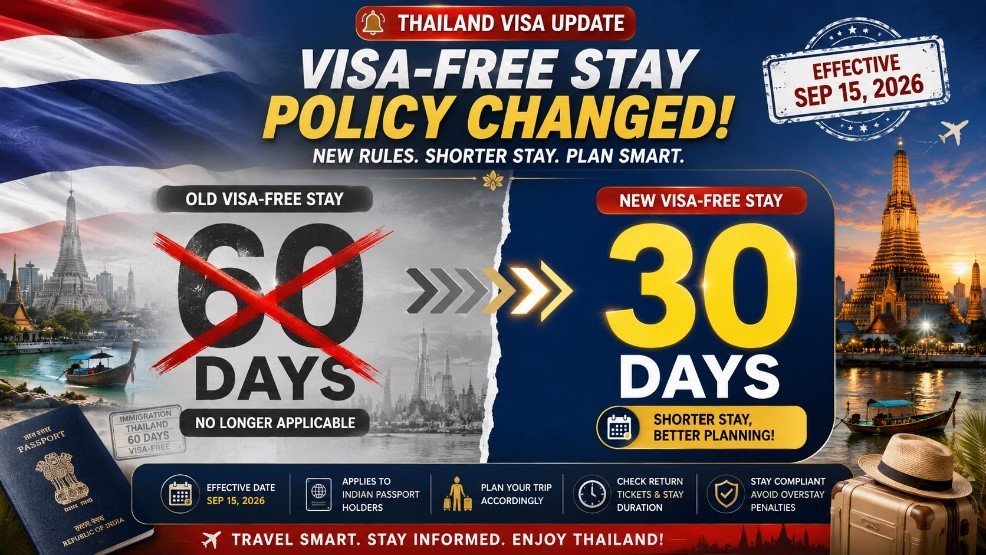
If Thailand has been sitting on your travel list for a long, leisurely holiday, there’s a change you need to know about before you book those flights. Starting September 15, 2026, Thailand is halving its visa-free stay for Indian passport holders — from 60 days down to just 30. For anyone planning a laid-back island-hopping trip, a digital nomad stint in Chiang Mai, or a multi-city Southeast Asia loop, this is a rule change that directly affects how you plan your itinerary, your bookings, and your budget.
This guide breaks down exactly what’s changing, who it affects, and how Indian travellers can adapt their plans without any last-minute surprises at immigration.
Background: Why Is Thailand Making This Change?
Thailand introduced its generous 60-day visa-exemption scheme in July 2024, extending it to passport holders from dozens of countries, including India, to boost tourist arrivals after the pandemic slump. It worked — arrivals climbed steadily, and Thailand remained one of the most accessible long-stay destinations in Asia for Indian travellers.
But the policy came with side effects. Thai authorities, along with industry bodies like the Association of Thai Travel Agents and the Thai Hotels Association, flagged growing concerns around tourists overstaying their welcome in a different sense — using the long visa-free window for informal employment, running unlicensed businesses, and illegally subletting condominiums meant for residential use. The government has been direct about the motivation: curb misuse without discouraging genuine tourism. The new rule was formalised through a Ministry of Interior notification published in the Royal Gazette on August 31, 2026, and takes effect 15 days later, on September 15, 2026.
What Exactly Has Changed
| Aspect | Old Rule (Since July 2024) | New Rule (From Sept 15, 2026) |
| Visa-free stay | Up to 60 days | Up to 30 days |
| Countries covered | 93 countries and territories | 60 countries and territories (India included) |
| Extension at local immigration | Up to 30 extra days | To be confirmed under revised framework — apply for an e-Visa if longer stay is needed |
| Land border entries | Unrestricted resets by exiting and re-entering | Capped at 2 visa-exempt land entries per calendar year |
| Resetting stay via land border exit-re-entry | Allowed | No longer allowed |
Importantly, India remains on Thailand’s visa-free list — this isn’t a case of Indian travellers being singled out or losing visa-free access altogether. The change applies uniformly across all 60 eligible countries, including Australia, the UK, the US, Germany, Japan, Singapore, and the UAE.
Step-by-Step: How the Transition Works
- Travelling before September 15, 2026? You’re unaffected. Entries made before this date continue to enjoy the existing 60-day visa-free stay.
- Already in Thailand when the rule changes? Your permitted stay won’t be shortened retroactively — you can remain until the original 60-day period you were granted on arrival expires.
- Entering on or after September 15, 2026? You’ll automatically be granted 30 days visa-free at immigration, no separate application required for tourism purposes.
- Planning to stay longer than 30 days? You’ll need to apply for the appropriate Thai e-Visa in advance through the Royal Thai Embassy or Thai e-Visa portal — visa-free entry won’t stretch further.
Planning to cross land borders (e.g., from Laos, Cambodia, or Malaysia) to “reset” your stay? This loophole is closed. Land border visa-exempt entries are now capped at two per calendar year, and re-entry no longer resets your clock.
Benefits — Yes, There Still Are Some
It’s easy to focus only on the downside, but a few things work in travellers’ favour:
- No loss of visa-free access — India hasn’t been dropped from the list, unlike stricter measures some countries impose.
- Zero paperwork for short trips — most Indian travellers visiting for 1–2 weeks (the vast majority) won’t notice any difference at all.
- Clearer, more predictable rules — the removal of the land-border “visa run” loophole may actually mean smoother, faster immigration queues for genuine tourists.
- e-Visa route still available — long-stay travellers, retirees, and remote workers have a legitimate path to extend beyond 30 days.
Eligibility & Requirements for the 30-Day Visa-Free Entry
- Valid Indian passport with at least 6 months’ validity from date of entry
- Purpose of visit must be tourism (business visitors need a separate visa category)
- Confirmed return or onward flight ticket
- Proof of accommodation for the duration of stay
- Sufficient funds as per Thai immigration guidelines (cash or bank statement, if asked)
- Entry limited to a maximum 30-day stay per visit under the exemption
Costs & Timeline
| Item | Details |
| Visa-free entry fee | Nil (no change) |
| e-Visa fee (for stays beyond 30 days) | Varies by visa category; apply via official Thai e-Visa portal |
| Processing time for e-Visa | Typically 3–7 working days; apply well in advance |
| Effective date of new rule | September 15, 2026 |
| Land border visa-exempt entries | Max 2 per calendar year |
Latest Tours and Travel Updates
Travel agencies and tour operators are already recalibrating Thailand packages in response. Expect to see more 15–25 day curated itineraries designed to comfortably fit within the new 30-day window, along with a push toward e-Visa-assisted long-stay packages for travellers wanting extended vacations, workations, or retirement-style stays in places like Phuket, Pattaya, and Chiang Mai. Airlines and travel platforms are also updating booking disclaimers to flag the new stay limit for Indian passport holders travelling after September 15.
Common Mistakes Indian Travellers Should Avoid
- Assuming the 60-day rule still applies if you’re booking travel now for a trip after September 15 — double-check your entry date against the cutoff.
- Planning a “visa run” via land border to extend your stay — this workaround is no longer effective and could complicate your immigration record.
- Booking a 45- or 50-day trip without an e-Visa, assuming you can extend once you’re there — apply in advance if you need more than 30 days.
- Ignoring accommodation and return-ticket proof — immigration checks have tightened alongside the new rule.
- Confusing tourist and business visa requirements — the visa-free scheme is strictly for tourism.
Expert Tips
- If your trip spans the September 15 cutoff, check your exact entry date, not your booking date — the rule applies based on when you physically enter Thailand.
- For trips of 25–30 days, build in a buffer of a day or two rather than cutting it exactly to 30, to avoid overstay penalties from flight delays or itinerary changes.
- If you’re a frequent visitor to Thailand (for business, family, or long stays), it may be worth exploring Thailand’s long-term visa categories, such as the Destination Thailand Visa (DTV), rather than relying on repeated visa-free entries.
- Always carry a printed or digital copy of your return ticket and accommodation confirmation — Thai immigration has increased scrutiny at entry points.
Conclusion
Thailand’s shift from a 60-day to a 30-day visa-free stay doesn’t shut the door on Indian travellers — it simply means your planning needs to be a little sharper. Short getaways remain hassle-free, but longer stays now call for proactive e-Visa planning. The key is knowing your exact entry date, understanding the new land-border restrictions, and building your itinerary around the 30-day window rather than being caught off guard mid-trip.
Planning your next Thailand trip and want it to go off without a hitch? Elite Travel Guru helps you navigate visa rules, build the perfect itinerary, and book a stress-free Thailand holiday — whether it’s a quick 10-day escape or a longer e-Visa-supported stay. Get in touch with Elite Travel Guru today and let our experts handle the details while you focus on the adventure.
Frequently Asked Questions (FAQs)
1. Do Indians still get visa-free entry to Thailand? Yes. India remains on Thailand’s visa-exemption list; only the permitted stay duration has been reduced from 60 to 30 days.
2. From what date does the new 30-day rule apply? The new rule takes effect from September 15, 2026, as per the Royal Gazette notification published August 31, 2026.
3. What happens if I entered Thailand before September 15 under the 60-day rule? Your original 60-day permitted stay remains valid and won’t be shortened.
4. Can I still extend my stay beyond 30 days after the new rule kicks in? You’ll need to apply for an appropriate Thai e-Visa in advance if you want to stay longer than 30 days; on-arrival extension terms under the exemption scheme have changed.5. Is the visa-free stay reduction specific to Indian travellers? No, it applies uniformly to all 60 countries and territories on Thailand’s visa-exemption list, not India alone.