


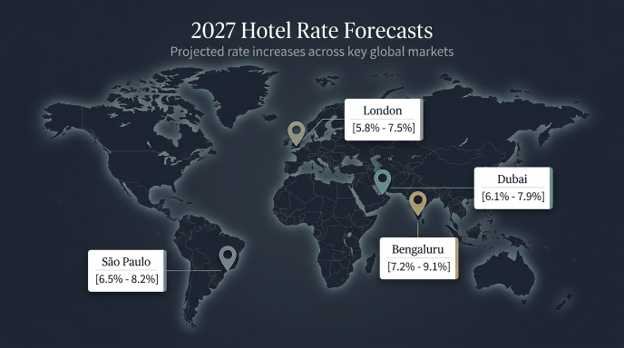
If you’ve been holding off on locking in 2027 travel plans hoping rates would finally cool off, American Express Global Business Travel has some news worth reading before you book. Its newly released Hotel Monitor 2027 forecasts hotel rate increases across nearly every major global market next year — continuing a trend that’s now stretched across multiple consecutive years. The twist this time is how the report is presenting its numbers: for the first time ever, Amex GBT is giving ranges instead of single-point forecasts, a direct acknowledgment of just how much geopolitical and economic uncertainty is baked into next year’s outlook. Here’s what the report actually says, city by city, and what it means for anyone planning travel — business or leisure — into 2027.
Background: What the Hotel Monitor 2027 Is and Why It Matters
The Hotel Monitor is Amex GBT’s annual forecast of hotel rates across key business travel destinations worldwide, built by combining the company’s own booking data with inflation and GDP forecasts from the International Monetary Fund, run through Prophet, an open-source time-series forecasting model. It’s one of the more closely watched industry benchmarks precisely because it draws on real transaction data at scale rather than survey sentiment alone, and corporate travel buyers use it to negotiate rates and set budgets well ahead of the year in question.
This year’s report breaks from its own tradition in one significant way: rather than a single projected percentage for each city, Amex GBT is presenting a range, and telling readers explicitly how to interpret it. According to Amex GBT Consulting’s Sara Andell, the lower end of each range should be used if the Middle East conflict doesn’t resolve quickly, or if global inflation tracks the IMF’s July World Economic Outlook forecast of 4.7% for 2026 — the upper end becomes more likely if inflation runs hotter than that.
What’s Driving the 2027 Increases
- Resilient corporate travel and meetings demand across the Americas and Europe, which continues to support pricing power for hotels in business-heavy markets
- Persistent inflation, still working its way through hotel operating costs and room rates globally
- Rising airfares, compounding the overall cost of travel alongside accommodation increases
- Constrained new hotel supply in several fast-growing markets, meaning demand is outpacing available room inventory
The ongoing Middle East conflict, which is having the opposite effect in Gulf markets — suppressing demand and, in turn, moderating rate growth
City-by-City Hotel Rate Forecasts for 2027
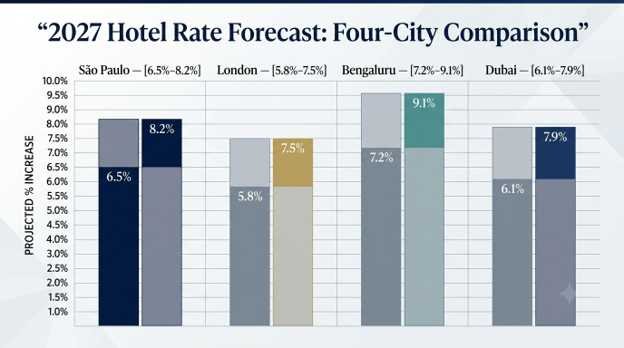
| City/Region | 2027 Forecast Range | Key Driver |
| São Paulo | 10.9% – 12.2% | Corporate demand, including Brazil’s expanding oil and gas sector |
| Buenos Aires | 8.1% – 8.7% | Strong regional corporate travel recovery |
| Santiago | 2.8% – 4.2% | Moderate regional growth |
| Madrid | 6.1% – 9.2% | Strong events and business travel demand |
| London | 3.6% – 5.4% | Sustained corporate and events demand |
| Paris | 3.1% – 4.8% | Leading events destination positioning |
| Mexico City | 4.7% – 7.1% | Resilient demand despite modest domestic growth |
| New York | 1.6% – 2.5% | Stable, mature market |
| Toronto | 0.5% – 1.9% | Near-flat North American trend |
| Sydney | Up to ~5.0% | Regional business travel recovery |
| Bengaluru | 5.0% – 5.5% | Global hotel chain expansion moderating steeper growth |
| Dubai | 1% – 2% | Middle East conflict suppressing occupancy and demand |
| Abu Dhabi | 1.7% – 4.1% | Similar regional demand pressure |
| Riyadh | 1.5% – 3.2% | Regional uncertainty, moderate growth |
Step-by-Step: How to Plan Travel Around These Forecasts
Step 1 — Identify which forecast range applies to your destination. Use the table above as a starting reference, then check the full Hotel Monitor 2027 report for additional cities not covered here.
Step 2 — Watch the Middle East conflict and IMF inflation updates. Both are the two variables Amex GBT explicitly says will determine whether your destination lands at the lower or upper end of its forecast range.
Step 3 — Book earlier for high-growth markets. Cities like São Paulo, Buenos Aires, and Madrid are forecast for the steepest increases — locking in rates sooner rather than later is more likely to pay off there than in flatter markets like Toronto or New York.
Step 4 — Consider Gulf destinations as a relative value opportunity. With Dubai, Abu Dhabi, and Riyadh all forecast for the mildest increases (and hoteliers reportedly working to win back visitors), 2027 could be a comparatively favourable window for Gulf travel.
Step 5 — Factor rising airfares into your total trip budget, not just accommodation costs, since the report notes airfare increases are compounding the overall cost pressure on travel.Step 6 — Revisit your plans if the underlying conditions shift. Since the entire report is built around a range tied to unresolved variables, a meaningful change in either the Middle East conflict or global inflation could shift which end of the range actually plays out.
Step 6 — Revisit your plans if the underlying conditions shift. Since the entire report is built around a range tied to unresolved variables, a meaningful change in either the Middle East conflict or global inflation could shift which end of the range actually plays out.
Benefits of Understanding the Forecast Early
- Better budget planning for both business and leisure travel well ahead of 2027
- Smarter destination selection, weighing relative rate growth across regions
- Improved negotiating position for corporate travel buyers using the same data hoteliers are aware of
- Early booking advantages in markets forecast for steeper increases
- A more realistic view of Gulf travel value, given the comparatively muted rate growth forecast there
Eligibility & Requirements
This isn’t a program with eligibility criteria, but the practical takeaway applies broadly:
- Corporate travel managers and procurement teams negotiating 2027 hotel rates should reference the Hotel Monitor’s city-specific ranges directly
- Leisure travellers planning 2027 trips can use the same data informally to time bookings in higher-growth markets
- Anyone budgeting multi-city 2027 itineraries should account for uneven rate growth rather than applying a flat global average
Costs & Timeline Snapshot
| Factor | Detail |
| Report publication | Published this week, covering 2027 rate forecasts |
| Forecast basis | Amex GBT booking data + IMF inflation/GDP forecasts, modeled via Prophet |
| Lower-bound trigger | Middle East conflict unresolved, or inflation at IMF’s 4.7% (2026) forecast |
| Upper-bound trigger | Inflation running above the IMF’s 4.7% forecast |
| Regions with steepest forecast growth | Latin America (São Paulo, Buenos Aires) |
| Regions with flattest forecast growth | North America, Gulf states |
Latest Tours and Travel Updates for 2026–2027
- UAE hotel occupancy fell as low as 19.6% in March 2026 amid regional conflict impact, before recovering to a 40–50% range — directly shaping Amex GBT’s restrained 1–2% Dubai forecast for 2027.
- India remains one of the fastest-growing business travel markets globally and is projected to be the world’s fastest-growing major economy in 2027, though rate growth in cities like Bengaluru is moderating as global hotel chains expand local supply.
- AI is reshaping hotel rate negotiation on both sides — the report notes hotels increasingly using agentic AI for revenue management, while corporate travel buyers deploy AI-powered sourcing tools to negotiate rates.
- Brazil has more than 20,000 hotel rooms in its development pipeline, but Amex GBT notes this inventory won’t arrive in time to ease 2027 rate pressure in São Paulo specifically.
Common Mistakes to Avoid
- Treating the forecast as a single fixed number. The entire 2027 report is structured as a range specifically because the outcome depends on unresolved variables — plan with that uncertainty in mind, not a false sense of precision.
- Ignoring regional variation. A “global hotel rates rising” headline obscures enormous differences between, say, São Paulo’s 10%+ forecast and Toronto’s sub-2% one.
- Overlooking airfare increases while focused only on hotel costs. Total trip cost pressure is coming from more than one direction in 2027.
- Assuming Gulf destinations will remain this affordable indefinitely. The muted Dubai and Abu Dhabi forecasts are tied specifically to current regional conditions, not a permanent value proposition.
- Booking blind without checking which end of the range is more likely for your specific destination, given current inflation and geopolitical trends at the time of booking.

Expert Tips
- If you’re planning travel to a high-growth market like São Paulo or Madrid, book well ahead of 2027 rather than waiting, since the forecast suggests meaningful upward pressure regardless of which end of the range materialises.
- Track IMF inflation updates periodically through 2026, since Amex GBT has explicitly tied its own range boundaries to that specific data point.
- If flexibility allows, consider Gulf destinations for 2027 travel while rates remain comparatively subdued relative to other global markets.
- For multi-city itineraries, budget city-by-city using the specific forecast range rather than applying one blended global assumption.
Frequently Asked Questions
1. Why are global hotel rates expected to rise in 2027? Resilient corporate travel and meetings demand, combined with persistent inflation, are the primary drivers, according to Amex GBT’s Hotel Monitor 2027.
2. Why is Amex GBT using ranges instead of single figures this year? The company cited ongoing geopolitical uncertainty, particularly the Middle East conflict, and commodity price volatility as reasons for presenting forecasts as ranges for the first time.
3. What is the hotel rate forecast for Dubai in 2027? Dubai hotel rates are forecast to rise just 1% to 2%, among the most restrained forecasts globally, as the Middle East conflict continues to suppress regional demand.
4. Which city has the highest forecast hotel rate increase for 2027? São Paulo, with rates forecast to rise 10.9% to 12.2%, driven partly by corporate demand from Brazil’s expanding oil and gas sector.
5. How is the Hotel Monitor 2027 forecast calculated? It combines Amex GBT’s own booking data with inflation and GDP forecasts from the IMF, modeled using the open-source Prophet time-series forecasting tool.
Conclusion: Plan Ahead, But Plan for a Range
Amex GBT’s Hotel Monitor 2027 makes one thing clear: hotel rates are heading upward in most of the world next year, but not uniformly, and not with total certainty. The decision to present forecasts as ranges rather than fixed numbers is itself useful information — it tells you exactly which real-world developments to watch before locking in travel plans, whether that’s the trajectory of the Middle East conflict or where global inflation actually lands.Elite Travel Guru helps travellers and businesses plan smarter around exactly this kind of forecast — booking strategically in high-growth markets, spotting relative value windows like the current Gulf outlook, and building realistic 2027 travel budgets. Contact Elite Travel Guru today to plan your next trip with the latest rate intelligence in hand.